





Patent

VS Legal

Patent means a new invention in form of a device/article or process of production. It should be invented and a novel one. Such patents are protected under the Patents Act, 1970.

A Patent is an intellectual-property relating to invention and is the grant of exclusive right, for a limited period, provided by the Government to the patentee, in exchange of full disclosure of his invention, for excluding others, from making, using, selling, importing the patented product or process producing that product for those purposes”.

The purpose of this system is to encourage inventions by promoting their protection and utilization so as to contribute to the development of industries, which in turn, contributes to the promotion of technological innovation and to the transfer and dissemination of technology. Under the system, Patent ensures property rights (legal title) for the invention for which patent has been granted, which may be extremely valuable to an individual or a Company. One should make the fullest possible use of the Patent System and the benefits it provides. Patent right is territorial in nature and a patent obtained in one country is not enforceable in other countries. The inventors / their assignees are required to file separate patent applications in different countries for obtaining the patent in those countries.

In simpler terms, a patent is an intellectual property that one claims as their own and can use it for their own purpose. If anyone wishes to use someone’s patent then they need to pay one royalty or one can even sell their patent.

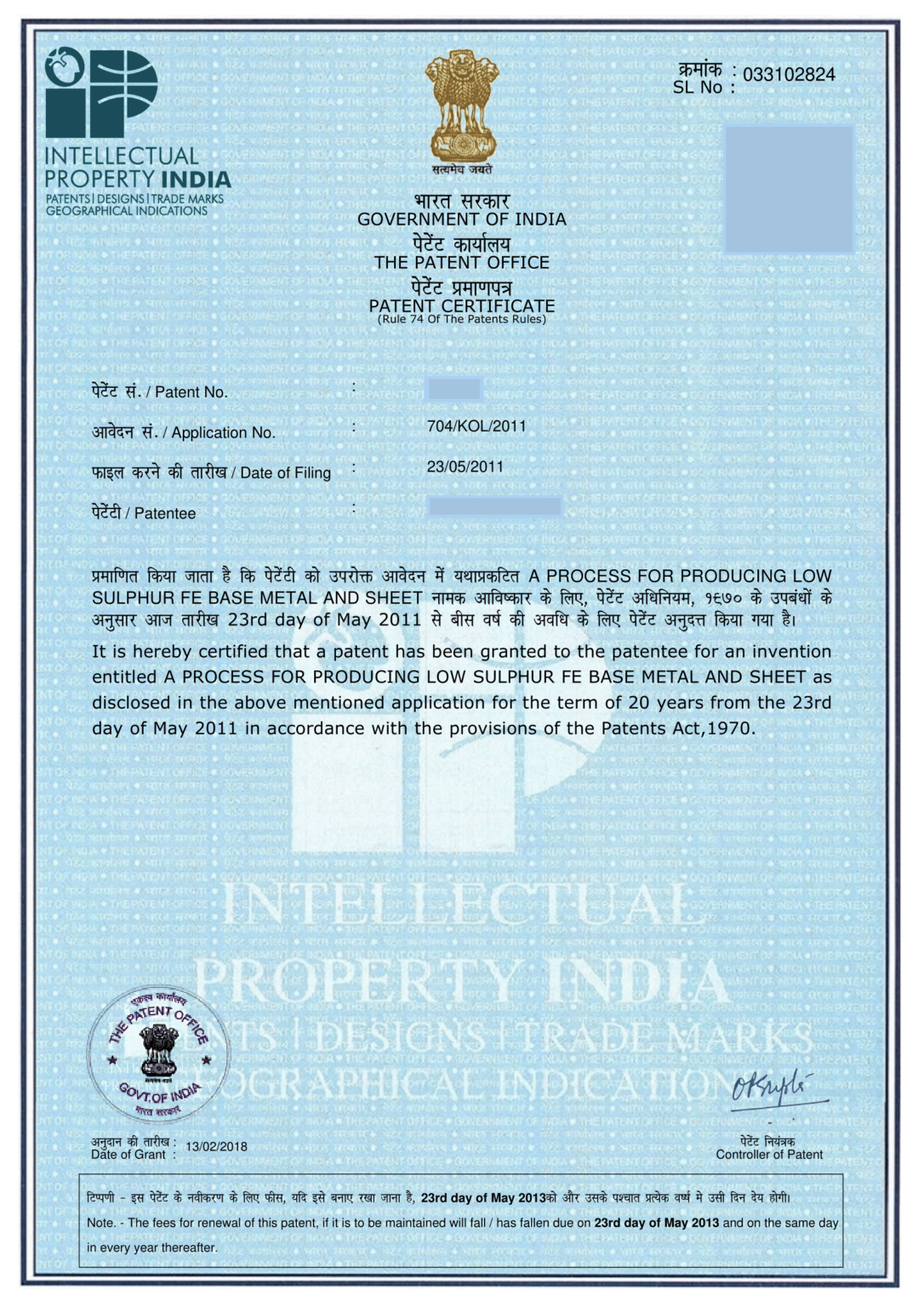
PATENT-CERTIFICATE-1-1086x1536

Types of Patent

VS Legal

ORDINARY APPLICATION

Ordinary application filed in Indian patent office with Complete specification (Description, Claims, Abstract, and Drawing). Description and claims pertaining to novelness of the invention which needs protection.

judges-evaluating-physics-project-science-fair_1324785-94406

CONVENTIONAL APPLICATION

Conventional application filed in India claiming earliest priority if your company is doing business internationally or intends to expand internationally and protect its Intellectual Property rights in India.

Wherein a conventional the application can be submitted within 12 Months from the International priority date, based on which your conventional application can be filed in India on or before the time specified as per Act. After which registration of your Patent is not possible. As you are aware India has great potential and a large market for innovative patents, hence we strongly advise you to protect your Intellectual property rights in India.

composite-image-thinking-businessman-holding-glasses_1134-44093

PCT APPLICATION

Patent application filed with PCT can be placed into the National Phase in India claiming the earliest priority if your company is doing business internationally or intends to expand internationally and protect its Intellectual Property rights in India.

India is following revised article 22 of PCT wherein a National Phase application can be submitted within 31 Months ( other countries follow a 30 Months deadline ) from the International priority date, based on which your PCT application can be filed in India on or before the time specified as per Act. After which registration of your Patent is not possible.

bright-idea-concept-with-woman-businesswoman_85869-4999

Benefits

Build Business

One can build a business around its invention and helps in raising capital for the same.

Owning Invention

One can own the invention for up to 20 years and you can stop anyone from using, selling or importing your invention in your country.

Licensing

One can also license (rent) their patent rights to companies in order to receive royalty.

Sell:

One can also sell their patent

Process

NDA (nondisclosure agreement) from other inventors
Patentability search
Application Draft
Application filling
Publication
Request Examination
Respond to the examination report
Hearing / Second Examination Report
Grant of Patent