

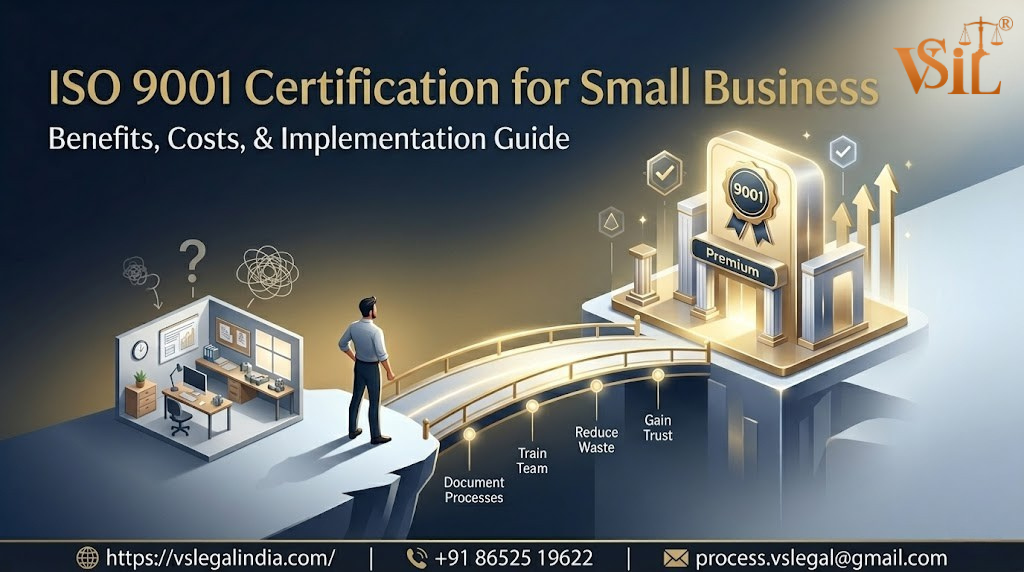
ISO 9001 Certification for Small Business: Benefits, Costs, and Implementation Guide
Most small business owners hear "ISO 9001" and assume it's a compliance checkbox for large corporations—something that requires months of consulting fees and doesn't directly impact their bottom line. That assumption costs them money. ISO 9001 certification for small business is actually a strategic investment that directly addresses three critical business challenges: losing contracts because customers demand it, wasting internal resources on inconsistent processes, and struggling to scale without documented systems. Having guided manufacturers, IT service providers, and B2B businesses through ISO 9001 implementation, VS IPR & LEGAL ADVISORS LLP has consistently observed that small businesses pursuing certification see measurable operational improvements within 6–12 months—typically a 15–20% reduction in rework costs and access to customer segments previously closed to them. Unlike generic ISO guides that focus on compliance requirements, this article positions ISO 9001 as a business investment with measurable ROI, provides realistic cost breakdowns (not vague ranges), and gives you a transparent implementation roadmap you can execute with or without external help. The core question isn't "What is ISO 9001?"—it's "Should my small business pursue it, and what's the actual path to get there?" This guide answers both.
What Is ISO 9001 and Why Does It Matter for Small Business?
ISO 9001 is an international quality management standard that establishes requirements for how organizations document, implement, and continuously improve their processes to consistently deliver products and services that meet customer expectations.
Small businesses should care about ISO 9001 because customers increasingly require it as a condition for contracts, and without it, you lose access to entire customer segments.
In practical terms, a quality management system means creating written procedures for how you handle customer orders, manage inventory, handle complaints, and track quality—then actually following those procedures and measuring whether they work. It's not about perfection; it's about consistency. If your business processes today depend on one person's memory or tribal knowledge, you have a quality management system problem. If a customer complaint reveals that three different team members handle the same task three different ways, you have a quality management system problem. ISO 9001 forces you to document the right way, train everyone to do it that way, and measure whether it's actually working.
For manufacturers supplying automotive companies, software vendors serving enterprises, or service providers competing for government contracts, ISO 9001 isn't optional—it's a table-stakes requirement. Without it, you don't get the bid. For other small businesses, ISO 9001 is valuable because it reduces internal waste, clarifies roles, and gives you a framework to scale without chaos.
ISO 9001 is distinct from other ISO standards. ISO 27001 focuses on information security management (protecting data and systems). ISO 45001 focuses on occupational health and safety. ISO 9001 is purely about quality management and process consistency—the broadest and most universally applicable standard.
| Standard | Primary Focus |
|———-|—————|
| ISO 9001 | Quality management and process consistency |
| ISO 27001 | Information security and data protection |
| ISO 45001 | Occupational health and safety |
Real Benefits of ISO 9001 for Small Businesses
Small businesses experience five tangible benefits from ISO 9001 certification: access to customers who require it, reduced internal rework and waste, competitive differentiation in crowded markets, faster employee onboarding and clarity, and documented proof of quality compliance for regulatory and customer audits.
Benefit #1: Customer Trust & Market Access
Customers in regulated industries increasingly require ISO 9001 from their vendors. A manufacturing small business that supplies automotive companies cannot bid on contracts without it. A software vendor serving financial institutions faces the same barrier. ISO 9001 certification removes this objection and opens access to customer segments that would otherwise be closed. Example: A precision machining shop in India gained three new automotive supplier contracts within six months of certification—contracts worth ₹15 lakhs annually—because customers could now verify quality consistency.
Benefit #2: Internal Efficiency & Cost Reduction
Documented processes reduce rework, scrap, and wasted time. When everyone follows the same procedure, mistakes decrease. A manufacturing small business that implemented ISO 9001 reduced rework by 18% in the first year, freeing up 6-8 hours per week of production time. A service business reduced customer complaint resolution time from 5 days to 2 days because the complaint-handling process was documented and everyone knew their role. These aren't theoretical benefits—they're measurable operational improvements that directly reduce costs.
Benefit #3: Competitive Advantage
In crowded markets, ISO 9001 certification signals professionalism and reliability. A small business competing against larger firms can use certification as a differentiator: "We're small enough to be responsive, but professional enough to have documented quality systems." This is particularly valuable in B2B markets where buyers evaluate vendor reliability. It's less valuable in consumer markets where customers don't know or care about ISO 9001.
Benefit #4: Employee Engagement & Clarity
When processes are documented, employees know exactly what's expected. New hires can be trained faster. Confusion about "who does what" decreases. Employees feel more confident because they're not guessing. A small IT services company reported that after ISO 9001 implementation, employee onboarding time dropped from 4 weeks to 2 weeks because new team members had clear documentation of processes and responsibilities.
Benefit #5: Regulatory Compliance & Risk Reduction
ISO 9001 creates an audit trail. If a customer claims you didn't follow your process, you have documentation proving you did (or evidence of where the process failed). This protects you in disputes. For manufacturers and food businesses, ISO 9001 demonstrates due diligence in quality control, reducing liability risk. For any business, it shows regulators that you take quality seriously.
The real benefit of ISO 9001 for small businesses isn't the certificate on the wall—it's the operational clarity and customer confidence that comes with it. VS IPR & LEGAL ADVISORS LLP helps small businesses across manufacturing, IT, and service sectors achieve this clarity through end-to-end ISO certification support, ensuring the investment translates into measurable business outcomes.
True Costs of ISO 9001 Certification
ISO 9001 certification for small businesses costs between ₹1,50,000–₹20,00,000 ($1,800–$24,000 USD) depending on whether you pursue a DIY approach, use moderate consultant support, or engage a full-service consultant, with costs driven by company size, process complexity, existing documentation, industry sector, and third-party audit fees.
| Cost Tier | Total Investment | Timeline | Consultant Hours | Documentation Drafting | Staff Training | Mock Audit | Certification Support |
|———–|——————|———-|——————|————————|—————-|———–|———————-|
| DIY/Minimal Support | ₹1,50,000–₹3,50,000 ($1,800–$4,200 USD) | 9–12 months | 0–10 | Self-directed | Self-directed | Optional | Minimal |
| Moderate Consultant Support | ₹5,00,000–₹10,00,000 ($6,000–$12,000 USD) | 4–6 months | 40–60 | Consultant-led | Consultant-led | Included | Included |
| Full Consultant-Led | ₹10,00,000–₹20,00,000 ($12,000–$24,000 USD) | 3–4 months | 80–120 | Complete | Complete | Included | Complete |
Cost Drivers Explained
*Company Size:* A 5-person business has simpler processes than a 50-person business. Fewer processes = lower documentation burden = lower cost.
*Process Complexity:* A manufacturing business with multiple production lines, quality checkpoints, and supply chain management has more complex processes than a service business with a single delivery model. More complexity = more documentation = higher cost.
*Current Documentation:* If you already have written procedures, process maps, and training materials, certification costs drop significantly. If you're starting from scratch, costs rise.
*Industry Sector:* Manufacturers and food businesses face stricter quality requirements and more detailed audit expectations. IT and service businesses typically have lower certification costs.
*Audit & Certification Fees:* The third-party auditor who certifies you charges ₹50,000–₹1,50,000 depending on company size and complexity. This is a fixed cost regardless of which tier you choose. Certification bodies must be accredited by recognized bodies like NABCB (National Accreditation Board for Certification Bodies) to ensure audit validity.
One-Time vs. Ongoing Costs
Certification is a one-time investment, but maintenance isn't free. Budget for:
- Annual Surveillance Audits: ₹75,000–₹1,50,000 ($900–$1,800 USD) per year. The auditor checks that you're still following your documented processes.
- Certification Renewal: Every 3 years, you undergo a full recertification audit. Cost: ₹1,50,000–₹2,50,000 ($1,800–$3,000 USD).
- Internal Training & Updates: When processes change or new staff join, you need training. Budget ₹25,000–₹50,000 ($300–$600 USD) annually for small businesses.
ROI Calculation Example
If ISO 9001 certification helps you win a ₹50 lakh contract you wouldn't have otherwise, a ₹10 lakh investment pays for itself in the first year. If it reduces rework costs by ₹2 lakhs annually, the investment is recovered in 5 years. Most small businesses see positive ROI within 18–24 months through a combination of new customer access and internal efficiency gains.
VS IPR & LEGAL ADVISORS LLP offers tiered implementation support ranging from documentation review to full certification management, helping small businesses optimize costs based on their readiness level. The firm's after-sales services and timely reminders on annual audits and renewal deadlines ensure ongoing compliance without additional administrative burden. Contact us for a personalized cost assessment and implementation roadmap.
Step-by-Step Implementation Guide
ISO 9001 implementation doesn't require hiring a full-time consultant or shutting down your business for months. Here's the realistic path:
1.
Assessment & Planning (Weeks 1–2):
Start by understanding your current state and mapping your core business processes: How do you acquire customers? How do you deliver your product or service? How do you handle complaints? How do you manage suppliers? Identify gaps by comparing your current processes to ISO 9001 requirements. Do you have documented procedures? Do you train new employees? Do you measure whether processes are working? Most small businesses find 5–10 significant gaps. Finally, decide on your implementation approach: DIY with minimal consultant support, moderate consultant involvement, or full consultant-led. This decision drives your timeline and budget.
2.
Documentation (Weeks 3–8):
This is the core work. You need to document: Quality Policy (a one-page statement of your commitment to quality and customer satisfaction); Process Documentation (written procedures for your core processes like order handling, production, delivery, complaint resolution); Work Instructions (detailed how-to guides for specific tasks); Forms & Records (templates for tracking quality activities); and Management System Manual (a document that ties everything together). If you're using a consultant, they'll draft these. If you're doing it yourself, use ISO 9001 templates available from quality management resources and adapt them to your business. The key is clarity, not perfection.
3.
Internal Training (Weeks 9–12):
Train your team on the new processes. This isn't a one-time event—it's ongoing. New employees need training. When processes change, everyone needs retraining. Dedicate 2–4 hours per week to training during this phase. Appoint an internal "ISO coordinator"—someone responsible for maintaining the system, tracking compliance, and coordinating audits. This person doesn't need to be full-time; 5–10 hours per week is typical for a small business. In our experience working with small manufacturers and service providers, the documentation phase consistently requires 40% more internal time than initially planned—allocate accordingly to avoid timeline slippage.
4.
Internal Audit & Corrections (Weeks 13–16):
Conduct an internal audit to verify that your documented processes are actually being followed. This is a self-check before the official audit. Identify what's working and what needs adjustment. Make corrections. Run a mock audit (or have your consultant run one) to simulate the official certification audit. This reveals any remaining gaps.
5.
Certification Audit (Weeks 17–20):
Hire a third-party certification body to conduct the official audit. They'll review your documentation, interview staff, and observe processes. If everything is in order, you're certified. If there are minor issues, you'll have 30 days to correct them. Major issues require a re-audit.
Implementation Checklist
- [ ] Map current business processes
- [ ] Identify ISO 9001 gaps
- [ ] Decide on implementation approach (DIY, moderate, or full support)
- [ ] Draft quality policy
- [ ] Document core processes and work instructions
- [ ] Create forms and record templates
- [ ] Write management system manual
- [ ] Train all staff on new processes
- [ ] Appoint ISO coordinator
- [ ] Conduct internal audit
- [ ] Run mock certification audit
- [ ] Hire certification body
- [ ] Pass official certification audit
- [ ] Schedule annual surveillance audits
Timeline Reality Check
DIY approach: 9–12 months (requires significant internal time)
Moderate consultant support: 4–6 months (consultant handles documentation; you handle training and process refinement)
Full consultant-led: 3–4 months (fastest, but highest cost)
The timeline depends on your business complexity and how quickly you can dedicate internal resources. A simple service business might certify in 3 months. A manufacturing business with multiple product lines might need 6–9 months.
ISO 9001 vs. Other Certifications: Which Is Right for Your Business?
Decision Framework: Which ISO Certification Is Right for Your Business?
| Criterion | ISO 9001 | ISO 27001 | ISO 45001 |
|———–|———-|———–|———-|
| Primary Concern | Quality & Process Consistency | Data Security & Privacy | Workplace Safety |
| Industry Best Fit | Manufacturing, B2B Services, Automotive Supply | IT, Software, Financial Services, SaaS | High-Risk Operations, Construction, Mining |
| Customer Requirement | Quality Management | Information Security | Occupational Health |
| Implementation Priority | Start Here | Add If Data-Sensitive | Add If High-Risk |
| Typical Timeline | 3–12 months | 4–8 months | 3–9 months |
| Audit Frequency | Annual surveillance + 3-year renewal | Annual surveillance + 3-year renewal | Annual surveillance + 3-year renewal |
Choose ISO 9001 if:
- Customers require it (most common reason)
- You want to standardize and document your core business processes
- You operate in manufacturing, automotive supply, or B2B services
- You're scaling and need documented systems
Choose ISO 27001 instead if:
- You handle sensitive customer data or intellectual property
- You're a software company, IT services firm, or financial services business
- Data security and privacy are your primary concern
- Customers require information security certification
Choose ISO 45001 instead if:
- You operate in a high-risk industry (manufacturing, construction, mining)
- Workplace safety is a primary concern
- You want to reduce workplace accidents and liability
- Employees work in hazardous conditions
Choose Multiple Certifications if:
- You're a manufacturing business (ISO 9001 for quality + ISO 45001 for safety)
- You're an IT company handling customer data (ISO 9001 for quality + ISO 27001 for security)
- You want comprehensive management system coverage
Most small businesses start with ISO 9001. If your business has specific security or safety concerns, add the relevant certification later.
Common Mistakes Small Businesses Make During ISO 9001 Implementation
Mistake #1: Documenting What You Should Do Instead of What You Actually Do
Small business owners often write procedures describing the "ideal" process, not the real one. Then staff can't follow the documented process because it doesn't match reality. Solution: Document your actual process first. Then improve it if needed. ISO 9001 doesn't require perfection—it requires consistency between what you document and what you do.
Mistake #2: Creating Documentation No One Uses
You write a 50-page manual that sits on a shelf. Staff ignore it because it's too complex or irrelevant. Solution: Keep documentation simple and practical. Use flowcharts, checklists, and one-page work instructions. Make it easy for staff to reference during their actual work.
Mistake #3: Treating ISO 9001 as a One-Time Project
You get certified, then forget about it. The system decays because no one maintains it. Solution: Assign an ISO coordinator to maintain the system, track compliance, and update documentation when processes change. Budget 5–10 hours per week for ongoing maintenance.
Mistake #4: Underestimating Internal Time Requirements
You hire a consultant and assume they'll do all the work. But ISO 9001 requires your team to participate in process mapping, training, and audits. Solution: Budget internal time. Even with full consultant support, expect 10–15 hours per week of internal involvement for 3–4 months.
Mistake #5: Skipping Internal Training
You document processes but don't train staff thoroughly. When the auditor asks employees about procedures, they don't know them. Solution: Invest in training. Conduct initial training for all staff, then ongoing training for new hires and when processes change.
Mistake #6: Choosing the Wrong Certification Body
You hire a cheap auditor who rubber-stamps your certification without actually verifying compliance. Later, you fail a customer audit because your system isn't real. Solution: Choose a reputable, accredited certification body. Verify that your certification body is accredited by a recognized national accreditation body. They should conduct thorough audits and ask tough questions.
Frequently Asked Questions
What exactly does ISO 9001 certification mean?
ISO 9001 certification means a third-party auditor has verified that your business has documented quality management processes, trains staff on those processes, measures whether they're working, and continuously improves them. It's a formal verification that you have a functioning quality system, not just a certificate on the wall.
How long does ISO 9001 certification take?
Timeline depends on your approach. DIY: 9–12 months. Moderate consultant support: 4–6 months. Full consultant-led: 3–4 months. The actual certification audit takes 2–5 days depending on company size.
Can a small business with 5 employees get ISO 9001 certified?
Yes. ISO 9001 applies to businesses of any size. A 5-person business has simpler processes than a 50-person business, so certification is faster and cheaper. The standard scales to your business size.
What's the difference between ISO 9001 and ISO 9001:2015?
ISO 9001:2015 is the current version of the standard (updated in 2015). If you're getting certified now, you'll be certified to ISO 9001:2015. Older certifications to ISO 9001:2008 are no longer valid; businesses must upgrade to the 2015 version.
Do I need a consultant to get ISO 9001 certified?
No, but it helps. You can do it yourself if you have time and documentation skills. A consultant accelerates the process and reduces the risk of mistakes. Most small businesses use at least moderate consultant support.
What happens if I fail the certification audit?
If there are minor issues (called "non-conformances"), you have 30 days to correct them and submit evidence. If there are major issues, you'll need to undergo a re-audit. Most businesses pass on the first attempt if they've done the preparation work.
How much does ISO 9001 certification cost in India vs. USA?
Costs are lower in India due to lower consultant and auditor fees. India: ₹1,50,000–₹20,00,000 depending on tier. USA: $2,000–$25,000. The process is identical; the cost difference reflects local market rates.
Is ISO 9001 certification worth it for a small business?
It depends on your situation. If customers require it or if you're losing contracts without it, it's absolutely worth it. If you want to reduce internal waste and scale more efficiently, it's valuable. If you're a small service business with simple processes and no customer requirements, the ROI is lower. Evaluate based on your specific situation.
How often do I need to renew ISO 9001 certification?
Every 3 years. You'll undergo a full recertification audit. In between, you have annual surveillance audits to verify ongoing compliance. The certification is valid for 3 years from the date of issuance.
Can I lose ISO 9001 certification?
Yes. If you fail a surveillance audit or don't maintain your quality system, your certification can be suspended or revoked. This is rare if you're actively maintaining the system, but it's a real consequence of neglecting the system after certification.
What's the easiest industry to get ISO 9001 certified in?
Service businesses with straightforward processes (consulting, IT services, professional services) typically have the easiest path. Manufacturing and food businesses face more complex requirements and stricter audits. But any business can get certified if it's willing to do the work.
Conclusion
ISO 9001 certification for small business isn't a compliance burden—it's a strategic investment that directly addresses three critical challenges: accessing customers who require it, reducing internal waste through documented processes, and scaling without chaos. The real cost isn't the certification fee; it's the internal time and consultant support required to build a functioning quality system. But that investment pays dividends through new customer access, operational efficiency, and the confidence that comes from knowing your business runs consistently. The path to certification is straightforward: assess your current state, document your processes, train your team, audit yourself, and pass the official certification audit. Whether you do it yourself over 9–12 months or use a consultant to accelerate the process to 3–4 months, the outcome is the same: a business that operates with clarity, consistency, and customer confidence. VS IPR & LEGAL ADVISORS LLP provides end-to-end ISO certification support tailored to your business size and complexity, ensuring the investment translates into measurable outcomes. The question isn't whether ISO 9001 is worth it—it's whether you can afford not to have it if your customers are asking for it.
 Contact Us